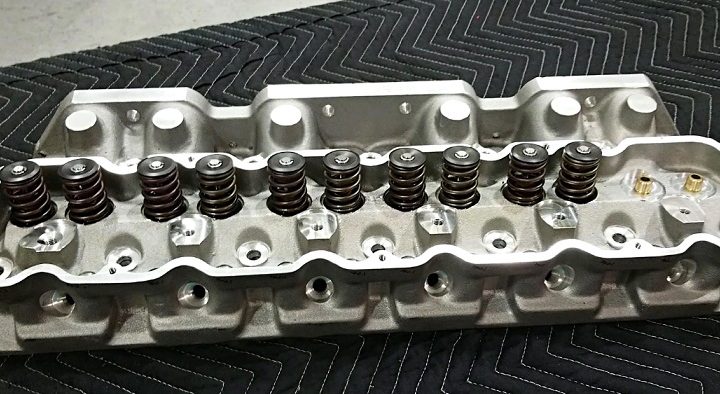
Valve springs are one of the most critical components of your engine. It is very important to match the camshaft and potential RPM range with the correct spring rate, which we will attempt to explain in this article in laymen terms. First, lets cover a little valve spring terminology.
-
Free Height - the overall height of the spring in an unloaded condition (when the spring is sitting on the workbench).
-
Open Height - the height of the installed spring when the valve is in a fully open position (when the spring is installed on the cylinder head).
-
Installed Height - the overall height of the spring in a loaded condition (when the spring is installed on the cylinder head).
-
Solid Height - the overall height of the spring in a fully compressed condition (when every coil touches the adjacent coils, above and below).
-
Coil Bind - the difference between the installed height and the solid height. The rule of thumb is - maximum valve lift equals the Coil Bind minus 10 percent, or .050 min.
-
Seat/Closed Pressure - the specified load (by design) on the spring when the valve is in a fully closed position, measured in lbs per square inch.
-
Nose/Open Pressure - the specified load (by design) on the spring when the valve is in a fully open position, measured in lbs per square inch.
-
Spring Rate - the amount of weight required to compress the spring by one inch, rated in lbs/sq.in. (not to be confused with Spring Rating - see below).
-
Spring Rating - specifies load when fully closed (Seat Pressure) and fully open (Nose Pressure), may be a range or a specific number. Example: 80-85/160-165 or 80/160.
-
Load @ Open Height - the actual load on a spring, when the valve is in a fully open position (replace spring if not within 10% of the minimum specified Open Pressure).
|
Installed
Height |
Solid
Height |
Coil
Bind |
Maximum
Valve Lift
|
Camshaft
Valve Lift |
Rocker
Ratio |
Actual
Valve Lift |
Difference |
Acceptable |
#1 |
1.680 |
1.100 |
0.580 |
0.522 |
0.480 |
1.5 |
0.480 |
+ 0.042 |
YES |
#2 |
1.680 |
1.100 |
0.580 |
0.522 |
0.480 |
1.6 |
0.512 |
+ 0.032 |
YES |
#3 |
1.680 |
1.100 |
0.580 |
0.522 |
0.480 |
1.65 |
0.528 |
- 0.006 |
NO |
#4 |
1.600 |
1.100 |
0.500 |
0.450 |
0.480 |
1.5 |
0.480 |
- 0.030 |
NO |
#5 |
1.600 |
0.900 |
0.700 |
0.630 |
0.480 |
1.65 |
0.528 |
+ 0.102 |
YES |
Selecting Your Valve Springs |
Wives Tale: Too much spring pressure is hard on valves – In truth, what’s hard on valves is the speed at which they contact the valve seat when closing. What dictates how hard the valve hits the seat? It’s supposed to be the camshaft closing ramp (shape of the cam lobe), but when the spring pressures are too low, the valve does not follow it’s intended path and instead slams into the seat and actually bounces. Hence higher spring pressures can actually aid the valve by forcing it to more closely follow the shape of the cam lobe. However to much valve spring pressure adds power robbing friction and increases valve train component wear. Therefore it is important to match the spring pressure to the profile of the camshaft, and the intended RPM range of the motor. Basically, more lift for a given duration (faster ramp speeds), and/or higher rpm's, require more spring pressure.
Stock springs will float around 4500rpm on a stock cam, and as such they are not suitable for performance camshafts. While a shim can be installed under the spring to increase spring pressure, and the intended rpm range, it's better to use a stiffer spring to avoid any possibility of coil bind. Small Block Ford (SBF) V8 valve springs (289/302/302HP) work well on stock and/or mild performance cams. Or you can use a single spring with a damper to reduce damaging harmonics in the valve train. The only drawback to using dampers, is that they usually require machining the valve spring seat. Dual springs are used for high performance cams and/or cams that frequently see high rpm's, such as during drag racing. On the other hand, softer spring pressures can be used to reduce wear and tear on the valve train components, providing rpm ranges rarely exceed 4500-5000rpm.
When installing a new camshaft or valve springs, always check and verify the installed height, seat pressure, nose pressure, coil bind, retainer to rocker arm clearance, and retainer to valve seal clearance. Failure to do so may result in severe engine damage, and voids all camshaft and/or spring warranties. |
Clay Smith and SSI Valve Springs are precision wound, shot-peen'd, detailed, heat-treated, and made from the finest silicone and/or stainless wire available.
Stock Replacement Single Springs are intended as replacement springs for stock low lift cam profiles only, and low rpm ranges which do not exceed 4500rpm.
SBF Single Springs (289/302/302HP) may be used with performance cam profiles, however special care must be observed when installing them. It is very important to verify the spring clearances whenever new springs are installed, particularly coil bind. This is especially true if your using a high lift performance camshaft, which requires higher spring pressures. To archive adequate pressures with a single spring, manufacturers commonly use a thicker material, which reduces the clearance between the coils. However if the springs are installed properly and the clearances are carefully checked, you should be OK. The use of single springs may void your camshaft warranty as well, however many engine builders prefer using single springs due to their ease of installation. In such cases the purchaser agrees to accept all responsibility, and/or liability, for any damages that might occur. If in doubt, use single springs with a damper or dual springs, just to be on the safe side.
Single Springs with Dampers, and Dual Springs are recommended for use in high revving engines with medium to high lift camshafts, or whenever high lift camshafts and/or high ratio rocker arms are used. The benefits of a single spring and damper or dual springs are three fold. Increased spring pressures which eliminate valve float at high RPM's, reducing coil bind in high lift applications, and increased safety in the event of valve spring breakage. Dampers offer an additional benefit of reducing damaging harmonics in the valve train components.
Spring Retainers: They are a wide variety of valve spring retainers are available from a wide variety of suppliers, however we recommend our one piece steel retainers, which fit all of our valve springs.
Valve Spring Cups: are recommended for all valve springs, as they prevent the spring from walking sideways. Valve spring seats, cups, or shims, must be used on aluminum cylinder heads to prevent abnormal wear and tear. Failure to use them invalidates the warranty.
| Classic Inlines Spring Specifications |
Part # / App |
Description |
Seat
Pressure |
Open
Pressure |
Coil
Bind |
Recommend
Cam Range |
Comments |
SSI-OEM-SPG
170/200/250ci |
Single Spring |
54 lbs |
150 lbs |
.430 |
Stock only |
Recommend
289 valve springs |
SSI-289-SPG 170/200/250ci |
|
|
|
.530 |
|
verify coil bind
and clearance
|
SSI-302-SPG
170/200/250ci |
|
|
|
|
|
Verify coil bind
and clearance
|
SSI-302-SPG-HP
170/200/250ci |
|
|
|
|
|
Verify coil bind
and clearance
|
CSC-200-SST
170/200/250ci |
Single Spring
w/Damper |
80 lbs |
170 lbs |
.925 |
up to 265 Dur. |
Viton Seals & Machining may be Required |
CSC-200-STY
170/200/250ci |
Single Spring
w/Damper |
100 lbs |
180 lbs |
.925 |
up to 275 Dur. |
Viton Seals & Machining may be Required |
CSC-200-TOY
170/200/250ci |
Dual Spring |
110 lbs |
260 lbs |
.925 |
up to 295 Dur. |
Viton Seals & Machining may be Required |
Spring Application Chart |
Spring |
Application |
SSI-200-SPG |
Stock springs should only be used on stock motors, which are intended for show only or occasional street use, that will never be rev'd over 4500 rpm. |
|
Stock 289 SBF springs are a great upgrade for stock motors used as daily drivers, but rarely rev over 5000 rpm. |
|
Stock 302 SBF springs are an excellent choice for stock or mild performance motors with our 264/274 camshafts. They are used for daily drivers or weekend cruisers which occasionally rev to 5500 rpm (6000 rpm maximum). |
CSC-200-SST |
These springs (with dampers) are a great upgrade for stock motors used as daily drivers, but rarely rev over 5000 rpm. While they are very similar to the 289 springs above, they include a damper to reduce damaging valve train harmonics. |
CSC-200-STY |
These springs (with dampers) are an excellent choice for stock or mild performance motors with our 264/274 vans. They are similar to the 302 springs above, however they include a damper to reduce damaging valve train harmonics. Rev range is 5000-5500rpm (6000 rpm maximum). |
CSC-200-TOY |
These dual springs are intended for performance motors with cams in the 260-280 range, which frequently see higher rpm ranges, up to 6500rpm. Dual springs increase open pressure to prevent valve float at higher rpm's, yet maintain an acceptable seat pressure, reduced friction and cam wear. |
Note: Installation of our single springs with dampers, and/or dual springs, may require machining to eliminate the cylinder head valve step on a stock cast iron cylinder head, which was intended to keep the stock single springs in correct alignment.
Note: To install .500 Viton seals, a valve cutter must be used to machine the valve guides, this helps to keep the seals securely seated on the guides once installed (.530 seals do not require machining). The .500 Viton seals are recommended when using dual springs, such as our CSC-200-TOY, as they increase the clearance between the seal and inner spring.
Machined valve guide |
Viton Seals .500/.530 |
Here's a chart to help you select the proper springs for your application and rpm range.
Cam Profile |
Intended Application - RPM Range
|
Show Car
max 4500 rpm |
Daily Driver
4500-5000 rpm |
Street/Strip
5000-5500 rpm |
Strip/Street
5500-6000 rpm |
Strip Only
6000+ rpm |
Stock Cam |
Stock |
289-SST |
289-SST |
302-STY |
302-STY |
264/264 |
289-SST |
289-SST |
302-STY |
302-STY |
TOY |
264/274 |
289-SST |
289-SST |
302-STY |
302-STY |
TOY |
274/274 |
289-SST |
302-STY |
302-STY |
TOY |
TOY |
278/278 |
302-STY |
302-STY |
TOY |
TOY |
|
280/280 |
302-STY |
302-STY |
TOY |
TOY |
|
294/294 |
302-STY |
TOY |
TOY |
|
|
 

|